


Cart
0
How Hair Actually Grows: The Science Behind the Cycle

How Hair Actually Grows: The Science Behind the Cycle
Most men never learn how hair actually grows until they notice it isn't. By then, the questions come fast — is this normal, is it permanent, what actually works. The answers start in the same place: the hair growth cycle.
Every strand on your head is running its own version of a four-stage cycle, on its own timeline, mostly out of sync with the strand next to it. Understanding those four stages doesn't just satisfy curiosity — it explains why hair routines take months to show anything, and why consistency, not any single application, is what the biology actually rewards.
The four stages of the hair growth cycle
Anagen — the growth phase
This is the active stage, when a follicle is producing hair and pushing it toward full length. At any given time, roughly 85–90% of the hairs on a healthy scalp are in anagen. On the scalp, this phase typically runs two to six years — which is why scalp hair can grow long, while eyebrow or arm hair, with a much shorter anagen phase, never does.
Catagen — the transition phase
A short, one- to two-week window where the follicle begins shutting down. Growth stops, the follicle shrinks, and the hair separates from its blood supply.
Telogen — the resting phase
The follicle goes dormant for around three months. The hair strand is still there, but it isn't growing.
Exogen — the shedding phase
The resting hair sheds, and the follicle resets to start the cycle again. Losing 50–100 hairs a day this way is considered normal — it's the follicle's ordinary turnover, not a sign that something's wrong.
What actually "switches on" a follicle
The interesting biology happens at the anagen transition — the moment a resting follicle re-enters growth. That switch is controlled by a signalling pathway called Wnt/β-catenin, which activates stem cells sitting in the follicle. When that pathway is active, the stem cells get the signal to start producing hair again. When it's suppressed — which a regulatory protein called CXXC5 does naturally as part of the cycle — the follicle stays dormant.
This is worth knowing because it reframes what a "hair growth" product is actually trying to do. It isn't adding hair from nothing. It's working with a cycle that's already running, trying to support the environment and signalling that decide how many follicles are active, and for how long, at any given time.
What can disrupt the cycle
The cycle isn't static — it responds to what's happening in the rest of the body. A few of the more common disruptors:
-
Genetics and DHT. In androgenetic alopecia (the most common cause of pattern thinning), follicles that are genetically sensitive to DHT gradually spend less time in anagen and more time in telogen with each cycle, producing progressively finer, shorter hairs.
-
Stress. A significant physical or emotional stressor can push an unusually large number of follicles into telogen at once — a pattern known as telogen effluvium, which shows up as noticeable shedding two to three months after the triggering event.
-
Nutrition. Follicles are metabolically active tissue, and deficiencies in protein, iron, zinc or certain B vitamins can shorten anagen or delay the cycle's return to growth.
-
Age. The anagen phase tends to shorten gradually with age, which is part of why hair can grow more slowly and to shorter maximum lengths later in life.
None of these operate on a fast timeline, which is exactly the point — cause and effect in hair growth are separated by months, so both problems and solutions take time to become visible.
Why consistency matters more than any single ingredient
Because the cycle plays out over months — anagen alone can run for years — nothing about hair growth happens in a single application. A serum used once tells you nothing. A serum used daily, across several full turns of the cycle, is a different question entirely.
That's the practical takeaway: the biology doesn't reward intensity, it rewards consistency. A routine you actually stick to will always outperform a stronger product used sporadically. It's also why so many routines fail — not because the formulation was wrong, but because the habit didn't survive long enough for the biology to catch up.
This is part of why Xeymora is built as a single daily system rather than a shelf of separate products to remember. Fewer decisions, easier to sustain — because the thing that determines whether a routine works is usually whether it's still being used in month four.
Where a daily routine fits in
This is the thinking behind Xeymora's two-Elixir system — a Morning Elixir and a Night Elixir, used together as one daily routine. The Morning Elixir is built on Biexum™, a multi-copper-peptide complex; the Night Elixir carries a complementary multi-peptide complex. Both are designed to support the scalp environment, cellular signalling and microcirculation that healthy-looking hair depends on — working with the cycle described above, not around it.
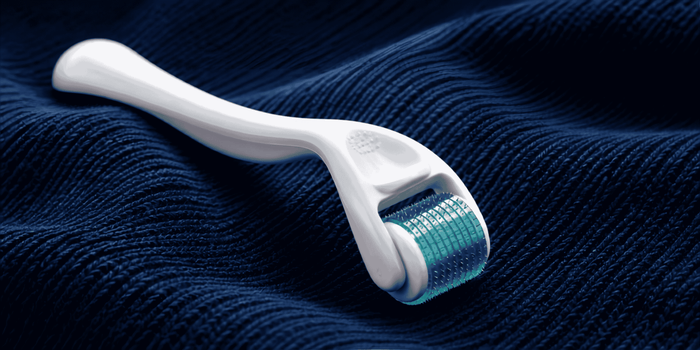
The included 0.25 mm derma roller, used roughly twice weekly, supports how well those actives are absorbed into the scalp.
None of this changes the timeline the biology sets. A full picture of change only shows up after the cycle has turned over more than once — which is the entire reason the routine is designed to be used daily, for the long run.
You might also like
Does Microneedling Actually Help Hair Growth? What a Derma Roller Does
A derma roller looks like the kind of thing that shouldn't work — a small drum of fine...
Read the story
Minoxidil vs. A Natural Alternative: What Men Should Know
Minoxidil comes up in almost every conversation about thinning hair, and for a reason — it's the most-studied...
Read the story